


Thriving together
Safeguarding & Wellbeing Support
Ivanhoe School fully recognises the contribution it can make to protect children and support learners in school. The aim of our Safeguarding Policy is to safeguard and promote our learners’ welfare, safety and health by fostering an honest, open, caring and supportive climate. The individuals' welfare is of paramount importance.
"All pupils we spoke to say that they feel safe in school. They know which staff to approach if they have an issue or a concern and they are confident that they will be helped to resolve it." - Ofsted
SEE SAFEGUARDING STAFF AND CONTACTS HERE
There are four main elements to our Child Protection Policy based on guidance from Keeping Children Safe in Education are:
- providing help and support to meet the needs of children as soon as problems emerge
- protecting children by following agreed procedures, ensuring staff are trained and supported to respond appropriately and sensitively to Child Protection concern
- taking action to enable all children to have the best outcomes by working proactively with parents (to ensure appropriate communications and actions are undertaken).
View our Child Protection Policy
Staff encourage children and parents to feel free to talk about any concerns and to see school as a safe place when there are difficulties. Children’s worries and fears will be taken seriously and children are encouraged to seek help from members of staff.
Our school will therefore:
- Establish and maintain an ethos where children feel secure and are encouraged to talk, and are listened to;
- Ensure that children know that there are adults in the school whom they can approach if they are worried or are in difficulty;
- Include in the curriculum activities and opportunities for PSHRE which equips children with the skills they need to stay safe from abuse (including online), and to know to whom they can turn for help;
- Ensure every effort is made to establish effective working relationships with parents and colleagues from other agencies;
- Operate safer recruitment procedures and make sure that all appropriate checks are carried out on new staff and volunteers who will work with children, including identity, right to work, enhanced DBS criminal record and barred list (and overseas where needed), references, and prohibition from teaching.
Safeguarding in the Curriculum
The following areas are amongst those addressed in PSHRE and in the wider curriculum:
- Bullying/Cyberbullying
- Drugs, alcohol and substance abuse
- E Safety/Internet safety
- Stranger danger
- Fire and water safety
- Road safety
- Domestic violence/Relationships/Consent
- Diversity issues e.g. forced marriage, Female Genital Mutilation (FGM)
- Honour Based Violence (HBV)
- Sexual exploitation of children (CSE)
- Extremism and Radicalisation
- Criminal Child Exploitation (CCE)
Operation Encompass
Leicestershire schools are part of Operation Encompass working with the police force. This knowledge sharing helps school staff in providing early intervention through ‘overt' or 'silent support’, depending upon the needs and wishes of the child. We believe that this kind of early intervention is every child’s right, and nurturing support helps learners feel confident that school is a safe place for them where their voice can be heard.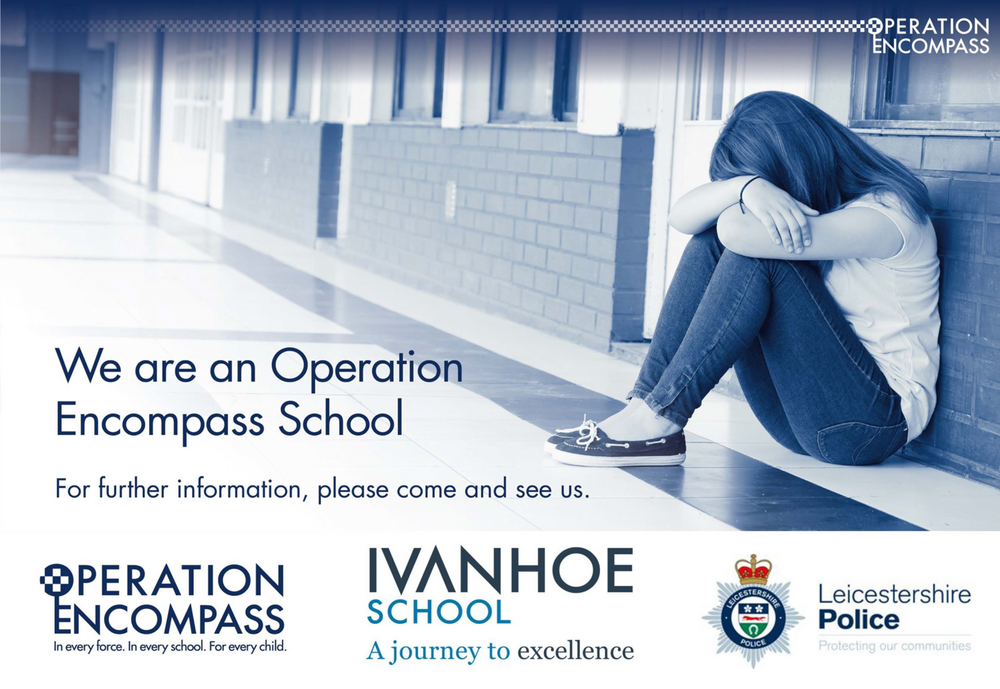
Incidences of domsetic abuse are often extremely traumatising for the child/children and their lived experiences can impact upon social, psychological, physical, emotional and behavioural health with an often negative academic outcome. Experiencing domestic abuse has been identified as an Adverse Childhood Experience.
In every classroom 1 in 5 children will have experienced domestic abuse at home by seeing, hearing or being a victim of emotional or physical abuse themselves.
Further support and advice can be accessed via the following links;
Domestic abuse - how to get help
PROTECTING YOUR CHILD ONLINE
We recognise that the Internet and digital platforms provide a vast opportunity for young people to learn. These advancing technologies allow all those involved in the education to promote creativity, stimulate awareness and enhance learning.
Hand in hand with the School’s desire for its learners to access every opportunity, there will be the need to keep them safe from the dangers of the Internet and digital platforms. We are committed to ensuring that all learners are able to use all technologies safely. We are also committed to ensuring that all those who work with young people; as well as their parents and carers, are educated about the dangers that exist so that they can take an active part in safeguarding.
Downloads
- Childnet International have produced a leaflet to help parents keep their children safe online, as well as giving helpful advice about the use of different technologies. To download it please click here.
- Childnet International have produced a list of resources and websites that students and parents can access if they get into difficulty online, or want more information about keeping safe. To download this list please click here.
- Internet Matters have produced a set of e-safety tips for parents of 11-13 year olds. To download it please click here.
External Links
Safer Internet Guide for Parents
Internet Matters Guide for Parents
www.ceop.police.uk/safety-centre


SEXTING - CHILD ON CHILD ABUSE
Sexting and sharing of consensual and non-consensual images.
There are many forms of Child-on-Child Abuse and one that seems to be more prevalent and possibly more accepted amongst students is ‘Sexting’ and ‘Sharing of consensual and non- consensual youth produced sexual imagery’ better known as nudes.
As a school we ensure that all our students are given appropriate guidance on using online technology, the laws around this and to ensure that they protect themselves online.
Despite this, social media’s influence and the pressure from peers is so great that children are continuing to engage in sexting. They are normalising these behaviours and not understanding the risk that they are putting themselves at and can lead to;
• Mental Health Issues (Anxiety, Depression)
• Victim and/or perpetrator of ‘grooming’
• Child Sexual Exploitation
• Bullying
• Harmful Sexual Behaviours
Once images are digitally shared, they no longer have any control over this even if shared with people they trust it may be forwarded making them vulnerable to humiliation and/or embarrassment which can lead to serious emotional distress. If posted online this can put them at risk of sexual predators who search the web for child sexual abuse images for their own gratification.
In the eyes of the law sending any form of youth produced sexual imagery ‘nudes’ whether they are consensual or non-consensual is a criminal offence and can lead to formal charges. Police often never want to criminalise children, however in most cases we are required to report incidents and they are recorded and considered should there be any further offences.
As a school we have a duty of care, however we are unable to monitor your child’s online activity 24/7. We want to be
able to support you in keeping your child safe online and would advise the following;
• Monitor your child’s activity and the platforms they are using to communicate.
• Check their camera roll, especially the recently deleted.
• Use parental controls, ensure these are updated regularly.
• Encourage them to use their technology in a family space.
• Restrict the amount of screentime.
We understand that technology plays a huge part in our children’s lives not only helping them learn but also to communicate so we need to ensure that they are able to useit responsibly and feel safe and confident to talk to us when
something has happened.
Being open with them and encouraging them to talk about what they are doing online is vital and there are some great
resources which can help support us all with achieving this.
Keep Children Safe Online: Information, Advice, Support- Internet Matters is a website that offers useful advice for
parents to help support in keeping children safe online.
There are other resources which you may find useful.
- E-safety for schools | NSPCC Learning
- Help & advice | Childnet
- Parents' Guide to Technology - UK Safer Internet Centre
- CEOP Safety Centre
- Resource Library (thinkuknow.co.uk)
What to do if you suspect that your child is engaging with sexting and sharing consensual or non-consensual youth produced imagery also known as ‘nudes’.
- Inform our Designated Safeguarding Lead who will be able to support and liaise with the Police if necessary.
- Do not ask to view the images, take their phone and prevent them from accessing social media. It is important that the image is not shared.
- If your child has sent an image, talk to them, ensure they understand the potential consequences and that it is a criminal offence.
• It is important that the image is deleted after the necessary professionals have been informed and once it has been confirmed that it is not required for police evidence.
Don’t forget, we are here to help. Should you have any concerns please do not hesitate to get in touch and we will
be more than happy to arrange to meet with you to talk through your worries.
Stay safe.
Vicky Sharpe
DSL and Safeguarding Manager
Tel: 01530 412756
Email: v.sharpe@ivanhoe.co.uk
These videos contain helpful tips for dealing with emotions.
Big Emotions -5 steps to Wellbeing
Big Emotions -Anger
>
Big Emotions - Low Self Esteem
Big Emotions - Trauma
Big Emotions - Sadness

Jen Steere (Headteacher)
North Street
Ashby de la Zouch
Leicestershire
LE65 1HX
Tel: 01530 412756
Email: office@ivanhoe.co.uk


